
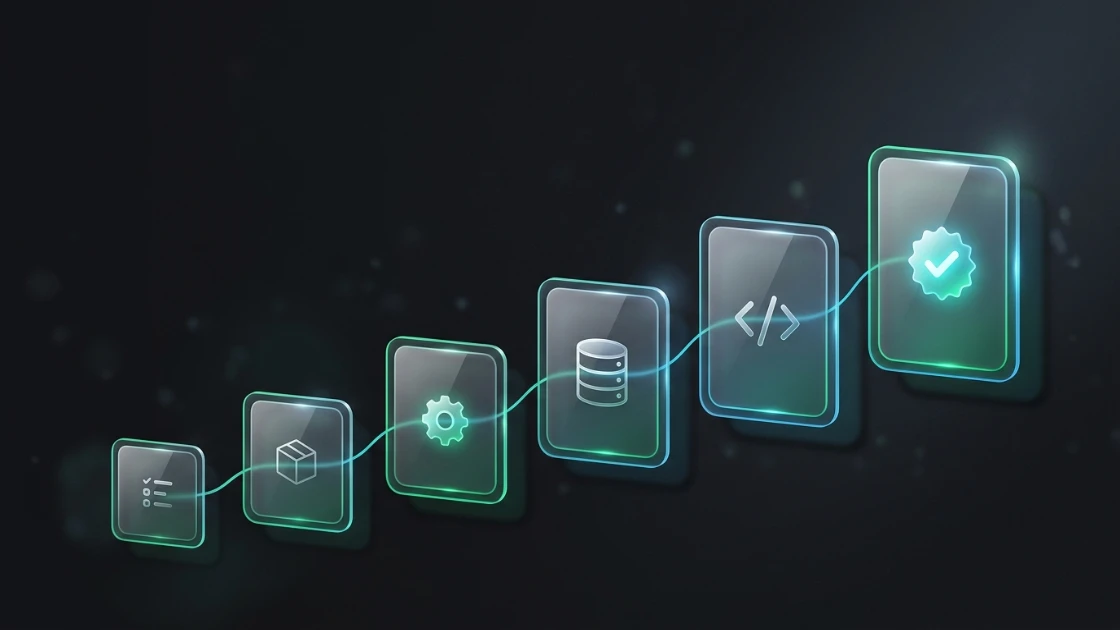
Building a Minimum Viable Product (MVP) is not about launching a half-baked, buggy application. Rather, it is about launching the simplest, most elegant version of your product that solves the core problem for your target audience.
In this guide, we break down our proven 6-week MVP development framework.
Week 1: Scoping & The "Must-Have" Filter
The biggest risk to an MVP is scope creep. To combat this, categorize every proposed feature into three lists:
- Core Value (Must-Have): Without this, the product has no purpose. (e.g., A booking app must let users book).
- Value Enhancer (Should-Have): Important, but the product functions without it. (e.g., Automatic invoice downloads).
- Nice-to-Have (Could-Have): Future optimization features. (e.g., Customizable themes).
*Only list 1 is built for the MVP.*
Weeks 2 & 3: UI/UX & High-Fidelity Wireframes
Startups cannot afford poor UX. Spend this phase designing clean, intuitive screens that guide the user through the primary action as fast as possible.
- Design for mobile-first.
- Keep branding clean and typography readable.
- Map out clear user flows: onboarding, action, success.
Weeks 4 & 5: Tech Stack & Core Engine Code
Select technologies that offer fast prototyping and seamless scaling. For frontend web, we recommend Next.js with Tailwind CSS. For the database, backend services, and auth, Supabase offers an incredibly fast and production-ready solution without spending weeks configuring servers.
- Setup user auth (email + password or OAuth).
- Build database schemas with relational sanity.
- Connect API routes and frontend pages.
Week 6: Testing, Polish, and Launch
Dedicate the final week to QA. Test critical paths on multiple devices.
- Verify sign-up/login processes.
- Ensure form submissions store data correctly.
- Configure analytics (Google Analytics/Clarity) to track how users behave.
Conclusion: By adhering to this timeline, you minimize cash burn, gather real-world customer validation, and establish a foundation ready to scale.